







When we think about metabolism, we almost always look at what we eat and how much we move. But there's a part of the process that goes unnoticed, and it happens every time you sit down at the table: digestion. And inside digestion there are some quiet protagonists almost nobody talks about — digestive enzymes.
If no one ever explained them properly, that's not your fault. It's simply information that's rarely told in plain language. So let's do that here: what they are, what they do, and where a supplement like Helpzymes™ fits into all of it.
What are digestive enzymes?
Digestive enzymes are proteins your own body makes to break food down into smaller parts. Think of them as a team of microscopic "scissors": when you eat, food arrives in pieces too large for the body to use, and the enzymes cut it into manageable parts.
That work happens mainly in the stomach and intestine, and it's a normal, constant step of digestion. There's nothing exotic about it — it's something your body does every day, meal after meal, without you noticing.
The three main types of enzymes
Each type of enzyme handles a different kind of food. It's a good example of how the body, far from being chaotic, works with very precise order:
- Proteases. They deal with proteins — meat, fish, egg, legumes — and break them down into amino acids.
- Lipases. They act on fats and separate them into fatty acids.
- Amylases. They work on carbohydrates and turn them into simple sugars.
It's an elegant system: each tool for its task. We're not talking about "curing" or "fixing" anything here — simply understanding how the process is designed on the inside.
The body is alive, and digestion is part of its rhythm
At NaturalSlim we like a simple idea from Frank Suárez: the body is alive — it learns and adapts. Digestion is part of that daily rhythm. Some people produce enzymes easily, and some, because of age or simply how their body works, produce them differently. That's neither good nor bad — it's just how each body is.
So rather than obsessing over every detail, we'd rather give you the background knowledge. As Frank used to say: "You can never solve a problem you don't understand." Understanding how digestion works is the first step to making better decisions about what you eat.
What is Helpzymes™?
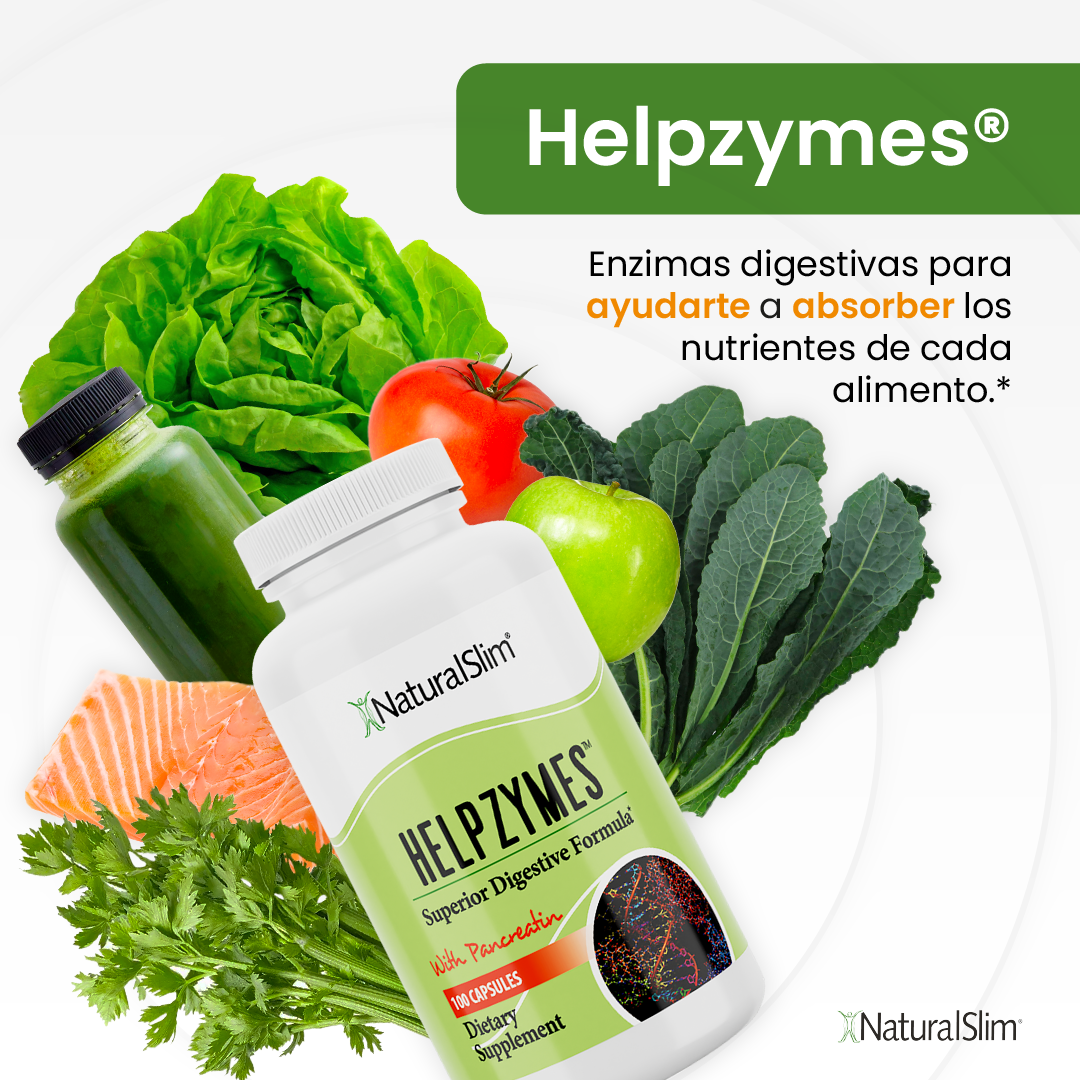
Helpzymes™ is a NaturalSlim supplement that provides a blend of digestive enzymes — protease, lipase and amylase, among others — plus pancreatin and hydrochloric acid, two components that are also a natural part of the digestive process.
Here it's worth being honest and clear: digestive enzymes have no authorized health claim at the European level. That means we can't promise you they will "improve your digestion", "reduce bloating" or anything of the sort — and be wary of any brand that promises that. Helpzymes™ is, quite simply, a supply of digestive enzymes, described exactly as it is. Nothing more, nothing less.
If you'd like to take a look, you can find it here: Helpzymes™ Digestive Enzymes.
Digestion within a wider approach
At NaturalSlim we don't believe in single-piece solutions. A supplement on its own is not a system. What really makes the difference is the whole: knowledge about your metabolism, nutrition adapted to your body type (what we call the 3x1 Diet® lifestyle), rest, and the support of someone who understands your situation.
Enzymes, your habits at the table, and the way you eat are pieces of that bigger puzzle. And because every body is different, the most useful thing is almost always to talk with someone who can look at your specific situation.
Where to start?
If you want to understand your digestion and your metabolism better, you don't have to figure it out alone, and there's nothing to buy to get started. At NaturalSlim Europe you have a team of Certified Metabolism Consultants™ ready to guide you, step by step, according to your case.
Knowledge is power — and understanding how your body works on the inside is almost always the best first step.

Share:
Vegetable Juices: An Easy Way to Add More Type A to Your Day
4 habits to reduce belly fat